 by
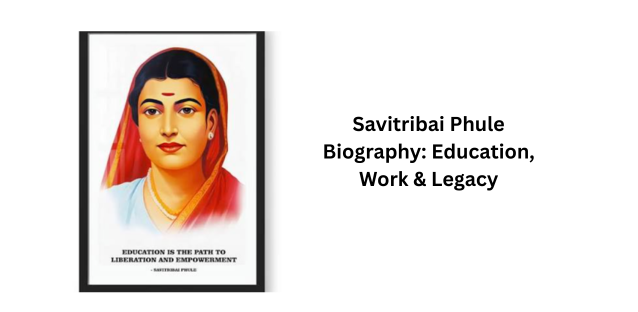
by Savitribai Phule (3 January 1831–10 March 1897) was a pioneering Indian teacher, poet and social reformer. This Savitribai Phule biography explores her contribution to girls’ education, women’s rights and social equality in India. Her journey demonstrates how education can challenge discrimination and bring meaningful change to society.
Table of Contents
Early Life and Education of SavitriBai Phule
Savitribai Phule was born on January 3, 1831, in Naigaon village in the Satara district of present-day Maharashtra. Like most girls of that period, she did not receive a formal education during childhood and was unable to read or write when she was married.
Savitribai’s education began after marriage with the support of Jyotirao Phule, who initially taught her at home. She later received teacher training at an institution associated with Cynthia Farrar in Ahmednagar and at a Normal School in Pune. This training prepared her to become an educator and work for people who had been denied access to education.
Savitribai Phule Marriage and the Phule Couple
Savitribai married Jyotirao Phule in 1840 when she was around nine years old. Although their marriage took place under the child-marriage practices common during that period, their later partnership became closely connected with education and social reform.
Jyotirao supported Savitribai’s education, while she developed into an educator and social reformer in her own right. Together, they challenged gender inequality, caste discrimination and social customs that prevented women and marginalized communities from receiving an education.
Savitribai Phule was Start of Women’s Education
In 1848, Savitribai Phule, Jyotirao Phule and Sagunabai helped establish a pioneering school for girls at Bhide Wada in Pune. It is widely recognised as one of India’s earliest modern girls’ schools founded by Indians. Savitribai worked as a teacher and later as a headmistress, becoming widely regarded as India’s first woman teacher.
The students were taught reading and writing along with subjects such as mathematics, science and social studies. At a time when girls were largely excluded from formal education, the school created an important learning opportunity for students belonging to different social backgrounds.
The First School for Girls
The school at Bhide Wada welcomed girls from different caste and social backgrounds, many of whom had previously been denied the right to study. Savitribai also worked with pioneering educators such as Sagunabai and Fatima Sheikh to extend education to girls and children from marginalized communities.
By 1851, Savitribai and Jyotirao Phule were running three schools for girls in Pune. Their work demonstrated that girls were equally capable of learning when they received proper opportunities, trained teachers and a supportive educational environment.
Savitribai Phule – Challenges and Opposition
Savitribai Phule’s revolutionary endeavors did not go unnoticed, and they were met with significant opposition. The orthodox sections of society strongly resisted her efforts, and the Phule couple had to face criticism, ostracization, and even threats. Yet, their resolve remained unshaken, and they continued to march forward in their mission to bring about positive change.
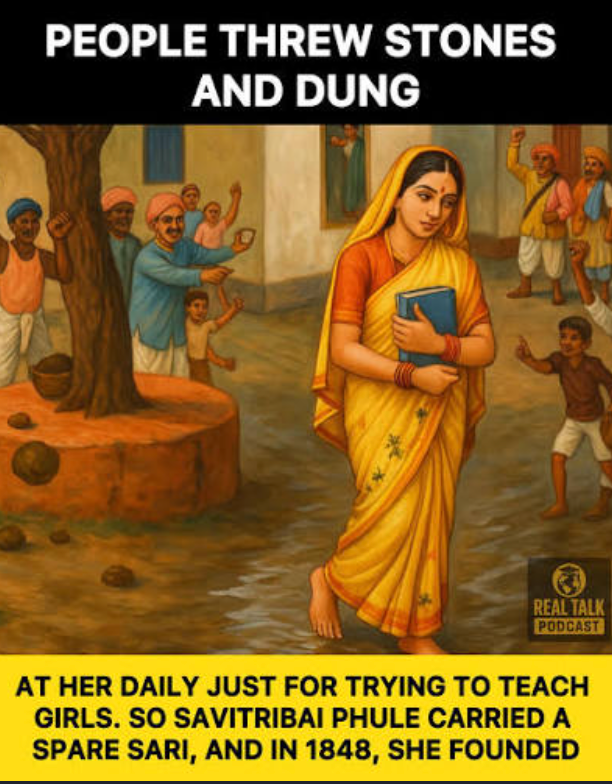
Opposition came from multiple quarters. Traditionalists who believed in maintaining the status quo saw the Phules’ efforts as a threat to their established power structures. Savitribai and Jyotirao, however, remained undeterred. They believed that education was the path to a more just and equal society, and they were willing to face any challenges to achieve this goal.
Savitribai Phule – Expansion of Educational Initiatives
As the years passed, Savitribai and Jyotirao expanded their educational initiatives. In addition to establishing schools for girls, they supported the education of children from communities that faced caste-based exclusion.
In 1863, the Phules established the Balhatya Pratibandhak Griha to support pregnant widows and other vulnerable women. It provided a place where women could give birth safely and confidentially while helping prevent infanticide caused by severe social pressure. The Phules later adopted Yashwant, who grew up to become a doctor.
Savitribai Phule was Writing and Activism
Savitribai Phule was not only an educator but also a poet and writer. Her first poetry collection, Kavya Phule, was published in 1854. Another important work, Bavan Kashi Subodh Ratnakar, was published in 1892.
Through her poems, speeches and letters, Savitribai encouraged oppressed communities to seek education and become self-reliant. Her writings challenged caste hierarchy, gender inequality and the social customs that restricted women’s freedom.
Social Reforms and Caste Abolition
Savitribai and Jyotirao actively opposed caste discrimination, untouchability, child marriage and the mistreatment of widows. They supported widow remarriage and promoted equal access to education regardless of a person’s caste or gender.
Jyotirao Phule founded the Satyashodhak Samaj in 1873 to promote social equality and challenge caste-based hierarchy. Savitribai actively participated in its work and continued supporting the movement after Jyotirao’s death in 1890. She also presided over the organisation’s Saswad conference in 1893.
Savitribai Phule Legacy and Honors
During the bubonic plague outbreak in Pune in 1897, Savitribai and her adopted son, Dr. Yashwant, established a clinic for people suffering from the disease. While caring for plague patients, she contracted the infection and died on March 10, 1897.
Savitribai Phule’s contributions to education and social equality continue to inspire generations. Numerous institutions have been named in her honour, including Savitribai Phule Pune University. Her life remains a powerful example of courage, compassion and dedication to education.
Conclusion
In conclusion, the life of Savitribai Phule is a shining example of what determination and a profound belief in education can achieve. Savitribai Phule’s journey continues to inspire teachers, students and social reformers. This Savitribai Phule biography reminds us that education can become one of the strongest instruments for equality, dignity and lasting social change.
Read Also –Kiyoshi Kuromiya Biography: A Pioneer in Activism and Advocacy


